How to Pick Apart and Identify Very Similar Chinese Characters
Created on January 16, 2026 02:29:01
Step 1
Details/No Actions
Before you read...
This guide assumes that you know some basic Chinese, have either studied Chinese and have a pinyin or zhuyin input method on your PC or mobile phone.
Step 2
Fluff Content (YOU DON'T NEED TO READ THIS!!!)
I have held off on explicitly talking about Mandarin and the Chinese language. Of course I've assumed that people who read these guides are familiar with pinyin and I also try to put some translation of characters and phrases in there, but I always fear that going off on tangents about Chinese will make me sound like one of those know-it-all users on Reddit or Facebook.
Anyways, hopefully this guide doesn't come off like that and instead will be helpful to people who are trying to wrap their head around Chinese like I constantly am 😂😂😂
The struggle is real...
Step 3
Details/No Actions
Hypothetical scenario:
I'm messaging someone in Chinese on LINE and they said "那是和平的象徵。"
I've never seen 象徵 before.
I know that 象 can mean elephant and it can mean appearance or like or akin to something.
I know that I've seen something like 徵 in the word for smile (which is 微笑 ).
I type to the person with my pinyin to character input and I say "一個大象的微笑?" ... I don't even notice that 徵 and 微 are different, because the font size is small and there is just a tiny difference between them, which is a single character component.
The person laughs and says “哈哈哈 不是這個意思! 徵 跟 微 就不一樣!”
I laugh with the person at my own ignorance and the learning process begins...
Step 4
Details/No Actions
FLUFF (blah blah)
Back in the day, I would look the two characters up on Pleco or Google or whatever and see what is different about them.
Nowadays, of course, I use ChatGPT all the time for my burning Chinese questions. But for this problem in particular, I had an idea. After using it for a few days, I find it really helping me keep these characters straight in my head.
Tool I made...
I made a Chinese character tool called Chai Jie 拆解 - (拆解 means breakdown or deconstruct).
It's not a dictionary, it's not Pleco. All it does is let you input a single character at a time and break apart the pieces (~ the components ~). You can also see the copy and paste-able pieces at the bottom for you to grab and put back in the search bar.
It is a work in progress at it has some bugs, and it is a PC friendly web version. You'll find that using it on a mobile device can be frustrating because the character components aren't as easily swiped. But never fear, this is a proof of concept for a mobile app that I hope to release within the year for iOS and Android.
You can find the tool here:
https://chaijieweb.vercel.app/
Tool another guy made...
Another tool I have found is https://learnchinese.ai/hanzi who also powered his site with the makemeahanzi svg dataset.
You can take a character and add it with a /<character-here> to this dude's URL and see a character component breakdown. Very similar to what I'm doing, but mine it more tactile and 'fun' because you get to throw the character components around.
Pleco...
Pleco also has a similar function for the basic most common characters.
Step 5
Actions
For the example above...
OK cool, so let's say you are me in that scenario above and you go use my chaijie website.
You input 徵 and then you pop open another tab of my website and put it 微 and you toss away all the common pieces (the components that they have in common).
You find yourself left staring at these two components :
王
兀
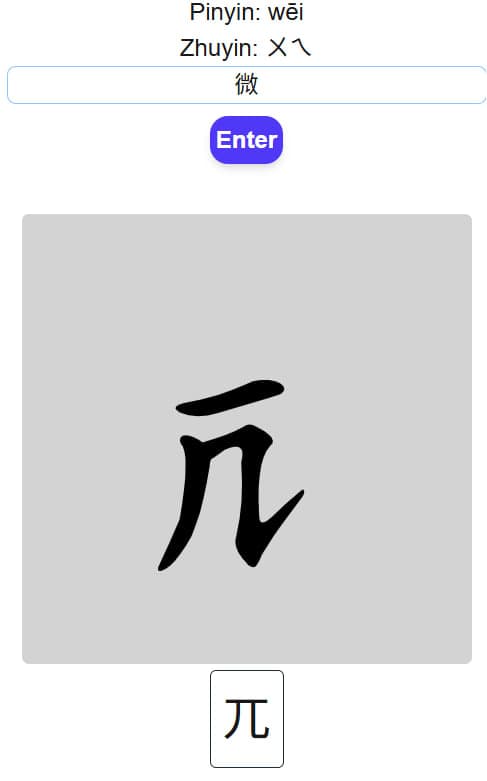
You know 王 already (it means prince and the pinyin is wáng ) but you don't know 兀 . You see that its pinyin is wù.
You probably also notice that this component - 兀 - looks different in the unicode compared to the draggable font (see screenshot below). These are called variants, and they are a big pain in the ass when you are trying to keep all of these characters straight. The variant here makes the component look like the simplified character 几 with a horizontal dash 一 on top.
Step 6
Actions
Awareness kicking in...
Switching the example back to me, let's say I go out into the world of Taiwan and I start staring at the various signs and posters in Chinese. Those characters start popping up everywhere!
I see 誠徵 written on a poster on a shop window and remember this 徵 that I'm seeing has the 王, and is therefore pronounced zhēng.
I even say to myself in my head '徵下面有個王'
Then later I'm on a Facebook group and I see a Taiwanese person commented on a post and wrote '這風格蠻微妙的欸' and you remember that 微 is pronounced wéi (or wēi if it's for 微笑 ) because it has that 兀 at the bottom.
Eureka moment begins and you start remembering just like a local does.
Step 7
Follow Up Actions
Obviously this experience / process is different for everyone, but I really do believe that learning Chinese characters this way is the best way. I describe characters by their components all the time with people 左邊有個 ‘方’ or 草字頭 or whatever.
It really helps to think of them that way, especially when there are so many very similar ones.
Here are some other crazy ones that I find fun to compare:
變 | 戀 | 欒
樂 | 藥
興 | 輿 | 與
騰 | 謄
刀 | 刃
辨 | 辯
壽 is also really fun to deconstruct in my chaijie app 😉
Happy Learning!